How to Give Feedback to a Former Peer After a Promotion
Updated: Oct 18
One week you compare notes as teammates. The next, you have to tell the same person that a client update was late or that their handoff made someone else's job harder. If you avoid the conversation, the work problem remains. If you make it about your new authority, you may damage a relationship that matters to both of you.
The aim is neither to “sound like a boss” nor to preserve the old relationship at any cost. It is to discuss one observable piece of work, hear the other person's account, and agree what happens next. This guide gives you a preparation sequence and words you can adapt. It cannot guarantee a particular response, and it is not a substitute for your organisation's formal procedures.

First decide what kind of conversation this is
Use an ordinary feedback conversation for a specific, recent work issue that you are authorised to address informally: a missed internal update, a handoff with missing information, or a meeting behaviour that made coordination harder. Pick a private time and a manageable next step.
Do not use this script as a workaround for a serious conduct concern, harassment, discrimination, a safety incident, a formal performance process, or a grievance. Follow your workplace policy and involve HR or another qualified person where appropriate. Nor should you promise confidentiality you cannot keep under that policy.
Illustrative scenario, not a customer story: A new team lead notices that a former peer sent the weekly status report after the account team had already met the client. The lead is tempted to say, “You never respect my deadlines now that I'm your manager.” That line guesses at motive and turns a fixable delivery problem into a dispute about status. The report timing, its effect, and the next deadline are the workable facts.
Prepare three facts before you speak
Write a one-sentence answer to each question:
What did you observe? Identify the time, task and observable action. “The Friday update reached the account team at 3:15 p.m., after its 2 p.m. client preparation meeting” is more useful than “You are unreliable.”
Why did it matter? Name the work effect without inflating it. “The team prepared without the latest risk list.” Do not claim a lost client or damaged reputation unless you can substantiate it.
What can change next time? Decide what result is needed, what support you can offer, and what decision is still open. “Can we agree a noon draft or an early warning if the risk list is not ready?” is a question, not a verdict.
The Center for Creative Leadership's Situation–Behavior–Impact (SBI™) model distinguishes the specific setting, observable behaviour and effect, then recommends asking about intent to make the discussion two-way. This article uses that model as an attributed reference, not as a Knowledge Skill Bank invention or a claim of CCL endorsement. Read CCL's explanation of SBI.
CIPD's public summary of its evidence review notes that feedback can help performance but can also be detrimental when handled poorly. This is one reason to prepare the conversation carefully and listen to the other person's account. Read the CIPD evidence review.
A five-minute conversation you can adapt
Start with the work, not the promotion:
“Could we spend five minutes on Friday's status update? I want us to make the next client handoff smoother.”
Describe what you saw and its effect:
“The update arrived at 3:15, after the account team met at 2. They didn't have the current risk list for that discussion.”
Ask for their view before prescribing a fix:
“What was happening on your side? Was the information late, the deadline unclear, or something else?”
Agree one specific next action together:
“For next Friday, let's aim to get the risk list to the account team by noon. If a dependency makes that impossible, message me by 10 so we can choose a different plan. Does that timing work with the information you need?”
Close with a check-in, not a threat:
“Let's see after the next handoff whether that solved the problem.”
These are original practice lines, not a transcript of a real employee conversation. Adjust the words to your workplace and the person's actual explanation. If their account changes the facts, update your understanding. A conversation is not a script-reading exercise.
When the old friendship enters the room
The former peer may hear any correction as proof that the relationship has changed. You do not have to deny that the reporting relationship changed; you do need to keep the work standard fair and consistent.
If they say, “You never used to talk to me like this,” try: “You're right that our roles changed. I still value a direct conversation with you. I'm raising this specific handoff because the team needs the information on time, and I would use the same standard with anyone doing this task.” Then return to the facts and listen.
If they say, “Are you singling me out?” do not answer with a vague assurance. Explain the task-related standard, check whether you have applied it consistently, and correct your approach if you have not. If the concern involves discrimination or retaliation, stop improvising and follow the proper process.
If they say, “I couldn't send it because another team was late,” ask which dependency failed and whether the early-warning point would help. Accountability includes giving someone a workable route to flag a blocker; it does not require them to control another team's work.
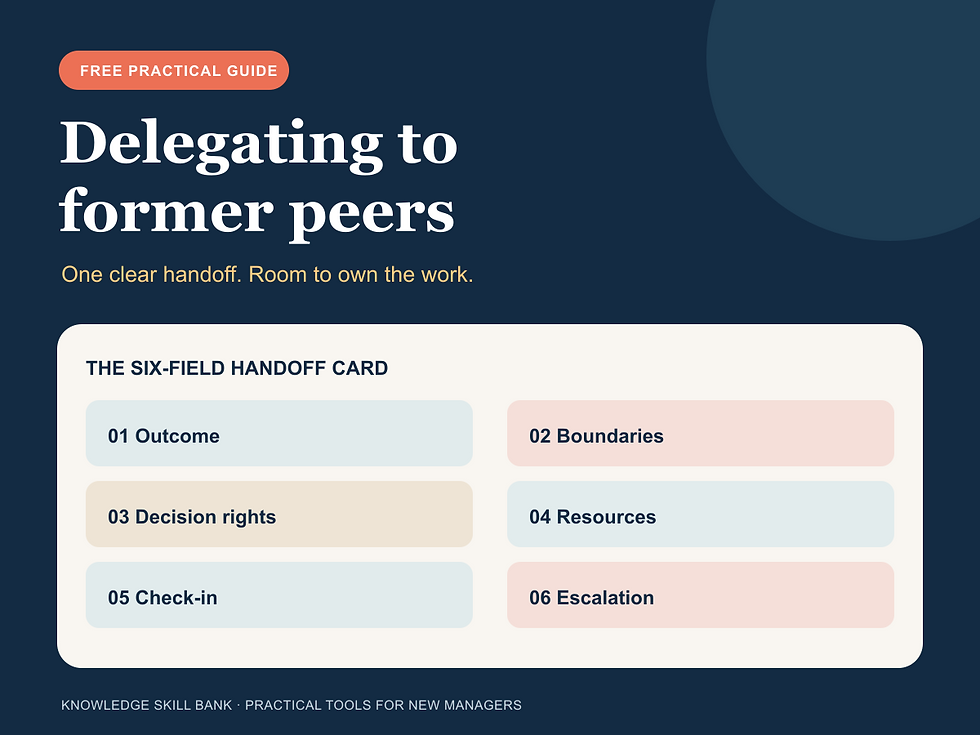
If the issue is simply that you never agreed who owned the handoff, do not relabel a management ambiguity as employee underperformance. Use a clearer assignment next time. Our six-field delegation handoff guide helps specify outcome, boundaries, decision rights, resources, check-in and escalation.
After the conversation
Send a short factual recap through the normal work channel if that is appropriate for your organisation: the task, agreed deadline, support or dependency, and check-in. Avoid character judgements or personal details. Keep records only in approved systems and for approved purposes.
At the agreed check-in, ask whether the work changed. If it did, acknowledge the concrete improvement. If not, revisit the cause and your organisation's process rather than repeating the same informal script indefinitely. A new manager should not try to handle a formal performance matter alone just because the other person used to be a friend.
Quick answers
Should I give feedback immediately after the mistake? Soon enough that the facts are clear, but not in front of the team or while either person cannot have a constructive conversation. Urgent safety or formal concerns follow the relevant procedure instead.
Should I mention that we were friends? Only when the relationship itself is affecting the discussion. Keep the standard anchored to the work and apply it consistently, whether or not you were close before the promotion.
What if I do not know whether the deadline was clear? Ask. If you never communicated it, start by fixing the expectation and the workflow. A vague handoff is not proof of poor attitude.
What if I need to discuss something more serious? Check your policy and get qualified HR or legal guidance for your location. This general guide does not cover disciplinary action, legal rights or investigations.
Download the free feedback conversation card
Want a one-page reminder for this conversation? Download our free printable US Letter PDF. It gives you spaces for observable facts, work impact, one genuine question, a two-way script and a specific next step. Print it and write in the boxes; it does not collect your email. The separate first-week checklist below is delivered by email after you request it.
Keep the wider transition manageable
For the first conversation about changed roles, use our first one-on-one agenda. For the broader transition, read how to manage former peers after a promotion.
If you are planning your first week, request the free first-week checklist by email. The checklist is sent after you enter your email; marketing updates are a separate optional choice. If you want deeper planning tools, explore the US$9 Essentials toolkit. The US$29 Complete Toolkit adds a Days 8–30 follow-through plan; eligible Essentials buyers should check the existing US$9 upgrade credit before buying, so the additional price is US$20 before applicable tax.
Sources and editorial boundaries
Knowledge Skill Bank editorial team · Prepared 6 October 2026. Sources: Center for Creative Leadership, Improve Talent Development With Our SBI Feedback Model and CIPD, Performance feedback: an evidence review. The scenario, dialogue and application to a former-peer relationship are original editorial examples, not customer results or research-validated outcomes. Neither source organisation endorses Knowledge Skill Bank. This is general workplace education, not HR or legal advice.