When a Former Peer Challenges Your Decision in a Team Meeting
Updated: Oct 18
You explain a deadline. Someone who sat beside you last month says, in front of the team, “That will never work.” You may feel pushed to prove you are now the manager. But the better first question is whether they have information the team needs, a concern you should hear later, or a pattern of interrupting that needs a separate conversation.

This guide is for an ordinary work disagreement during your first weeks managing former peers. It is not a script for misconduct, discrimination, safety allegations or formal grievances. Those need your organisation's process and appropriate qualified support.
In the meeting: protect both the decision and the discussion
The aim is not to win a status contest. Make the concern specific, state what has and has not been decided, and give the team a next step. That lets you hear useful dissent without allowing the meeting to become a personal referendum on your promotion.
Try this three-part response, in your own voice:
Name the work issue. “You are concerned that the handoff date leaves too little testing time. Is that the main risk?”
State the decision boundary. “The launch date is set by the client. The handoff sequence is still ours to adjust.”
Choose the next forum and owner. “Let's take two minutes to identify the failure point. I will confirm the revised handoff with the owners by 3 p.m.”
If the person raises a fact that could change a decision, do not pretend certainty. Say what you will check and when you will update everyone. If the meeting cannot resolve it safely, park the item with a named owner and date. Do not promise an outcome before you have authority or evidence.
Three responses for three different challenges
A concrete work risk: “That is a useful concern. Which step is most likely to fail? Let's identify the evidence we need before we change the plan.” You have invited detail, not surrendered the decision.
A broad dismissal: “I want to understand the specific problem. What would you change, and what trade-off would that create?” If no concrete issue emerges, return to the agenda and offer a short follow-up. Do not let a vague objection consume the whole meeting.
An interruption aimed at you personally: “We can disagree about the plan. Let's keep this about the work and let others finish. I will speak with you after the meeting.” Keep the boundary short; do not diagnose motives or deliver a public lecture.
These are practice examples, not words guaranteed to de-escalate a particular person. Adapt them to your authority, team norms and organisation's policies.
After the meeting: ask what was happening, then agree a work rule
Arrange a private conversation while the details are fresh. Do not open with “Why are you undermining me?” That assumes intent you may not know. Describe the observation and its effect on the work.
“During the planning discussion, you spoke over the handoff owner twice and said the deadline would never work. I want to understand the risk you saw. I also need us to give people room to finish and to make objections specific enough to act on. What was your concern?”
Listen for the substance. The person may have been right about a missing dependency; they may also have been frustrated about the new reporting relationship. Both can be true. Do not trade away a fair meeting standard in exchange for agreement with your decision. Ask what a useful challenge should look like next time: which information should be brought, when to raise it, and how the decision will be recorded.
Close with a small agreement: “You will bring the testing dependency to Thursday's planning check. I will confirm whether the handoff date can move. In meetings we will let the owner finish, then name the risk and a proposed alternative.” Send a factual recap only to the appropriate people; do not circulate private feelings or personnel information.
For an ordinary work conversation that needs more preparation, use our free feedback conversation guide. It separates observed behaviour, work impact and a reasonable next step.
A two-minute decision record
Use this small record after a contested meeting. Keep confidential details in approved systems only.
Decision: What is decided now, and what remains open?
Reason: Which work facts and constraints informed the decision?
Concern: What specific risk was raised, by whom only if appropriate to record?
Owner and date: Who will test or resolve it, and when will the team hear back?
Revisit trigger: What evidence would make us change course?
Example: “Client launch stays Friday; handoff order may change. Testing needs two full working days. Operations will verify capacity by Tuesday 2 p.m. If the test environment is unavailable, I will escalate the schedule decision to the project sponsor.” This is a plan with a trigger, not a promise that everyone will agree.
The value of the record is that a manager can correct a bad decision without pretending there never was one. It also makes it harder for friendship or frustration to become the hidden rule for who gets heard.
When this should not stay an informal one-to-one
If the challenge involves discrimination, harassment, retaliation, threats, safety, serious misconduct, confidential employee information or a formal complaint, do not use a generic meeting script as your investigation. Pause the ordinary discussion and use the reporting and support route required by your organisation and location. If you are personally involved or lack authority, ask your manager or HR who should handle it. Do not promise confidentiality you cannot provide.
For routine disagreement, a fair standard is more useful than treating every objection as disloyalty. Center for Creative Leadership's research on first-time managers highlights the need to reset expectations and treat former peers fairly. Acas guidance also distinguishes early informal conversation from matters needing formal process. Neither source tested this particular script or endorses Knowledge Skill Bank.
Choose the next useful tool
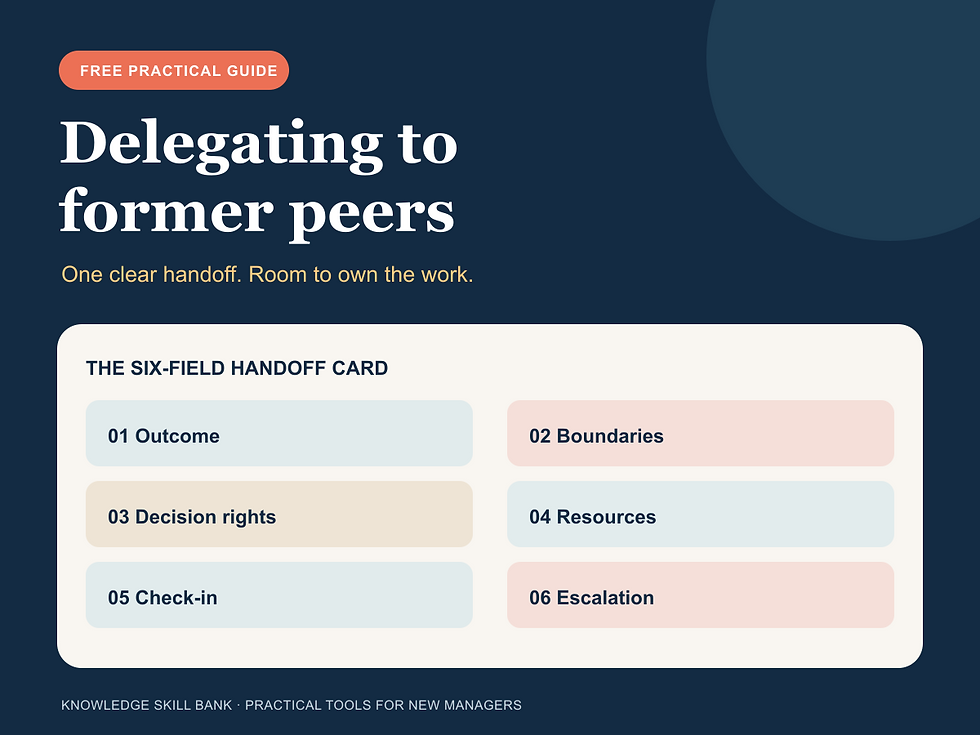
If the disagreement revealed an unclear role or handoff, use the free delegation handoff card. If you are mapping the whole transition, the free 30-day plan is usable without buying anything.

Prefer to start with the first week? Your First 7 Days Managing Former Peers — Essentials is a one-time US$9 digital download with an illustrated guide, practical worksheets and checklist. The Complete Toolkit includes the Essentials materials, so choose the starting point that fits you.
If you want the complete first-month system, Managing Former Peers: 30-Day Complete Toolkit is a one-time US$29 digital download. It includes the Essentials files, a 30-page guide, 15-page printable workbook and editable tools for decision boundaries, delegation, feedback and review. It is not coaching or a guaranteed workplace outcome. If you already bought Essentials, sign in with the same account and check that the existing US$9 upgrade credit appears before paying; Complete already includes Essentials.
Still in your first week? Request the free first-week checklist by email. Marketing updates are a separate, optional choice.
Sources and editorial boundaries
Knowledge Skill Bank editorial team · 14 October 2026. General background: Center for Creative Leadership, #1stTimeMgr research paper, pp. 9–10 (published 2014; source checked 14 October 2026); Acas, Dealing with a problem raised by a worker (checked 14 October 2026). These sources inform the general principles of clarity, fairness and appropriate escalation. The three-part response, scripts and five-field decision record are our original educational examples, not validated interventions, customer results or legal/HR advice. Neither organisation has endorsed this article or the paid toolkit.